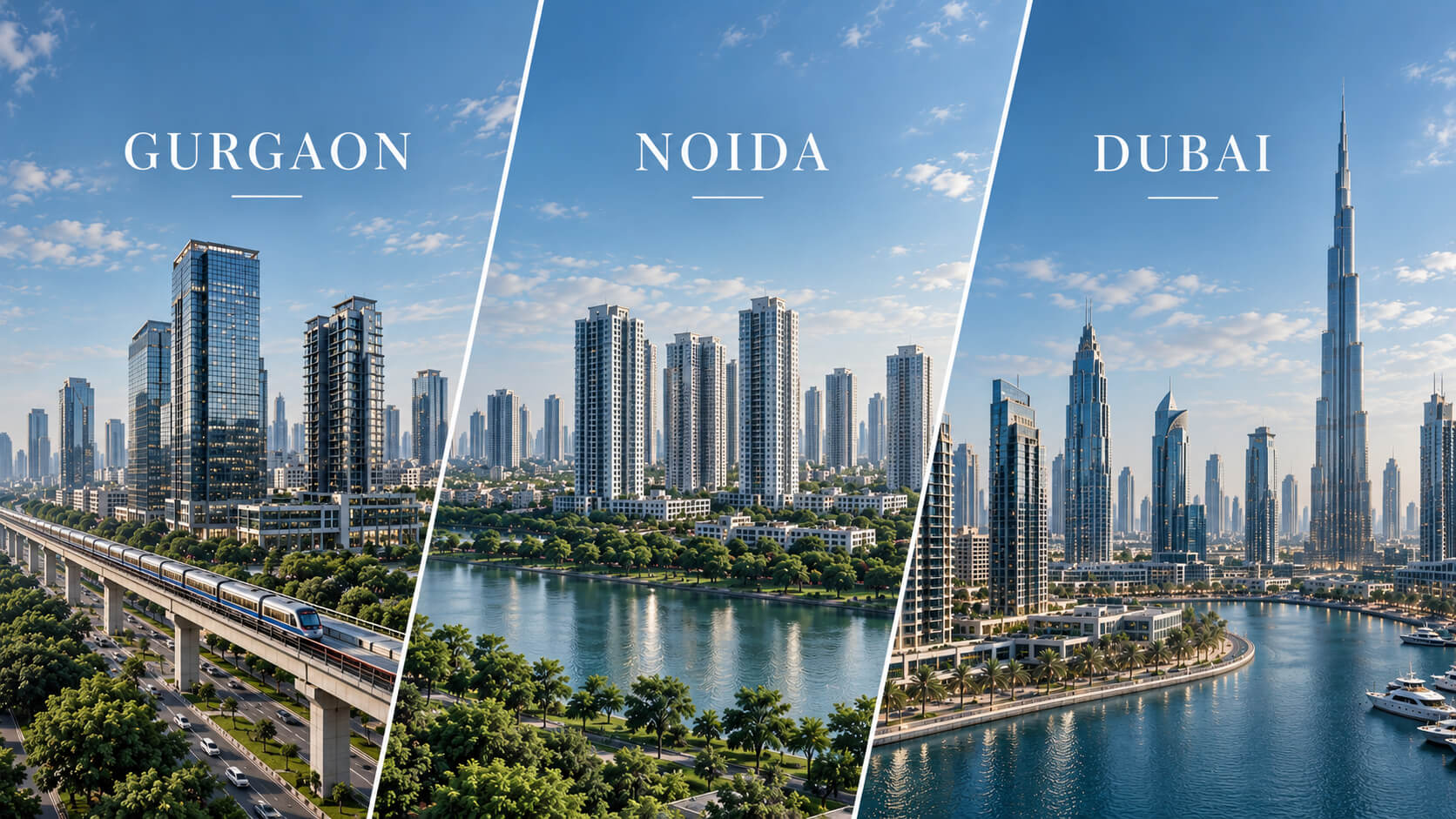
Should I invest in Gurgaon?
Or Noida?
Or Dubai?
At first glance, it sounds like a logical discussion.
After all, investors want to know where returns may be higher.
Where growth may be stronger.
Where opportunities may exist.
But after working with entrepreneurs, business owners, and senior professionals for years, I’ve noticed something interesting:
The most successful investors rarely start with geography.
They start with strategy.
Because in investing, the question is often more important than the answer.
And “Gurgaon, Noida, or Dubai?” is usually the wrong question.
Why Most Investors Think About Real Estate Incorrectly
When people compare locations, they often assume investing is primarily about selecting the best market.
This creates debates such as:
- Gurgaon vs Noida
- India vs Dubai
- Residential vs Commercial
- Ready-to-Move vs Under Construction
The problem is that these discussions often ignore the most important variable:
The investor.
Because the best investment for one person can be the wrong investment for another.
A founder with a concentrated business portfolio has different needs than:
- a salaried executive,
- an NRI,
- a retiring professional,
- or a second-generation business owner.
Without understanding the investor, the location discussion becomes incomplete.
The Real Question Sophisticated Investors Ask
Instead of asking:
Should I invest in Gurgaon, Noida, or Dubai?
Sophisticated investors ask:
What am I trying to achieve?
That single shift changes the entire conversation.
Because every investment objective requires a different solution.
For example:
If your goal is:
Wealth Preservation
Your approach may be very different from someone seeking aggressive growth.
Rental Income
You may prioritize yield-generating assets.
Capital Appreciation
You may focus on growth corridors and developing infrastructure.
Currency Diversification
You may consider international markets.
Portfolio Diversification
You may intentionally spread exposure across geographies and asset classes.
The answer depends on the objective.
Not the location.
Gurgaon: A Wealth Creation and Business Hub
Let’s begin with Gurgaon.
Gurgaon has evolved into one of India’s most important economic centres.
Its growth is supported by:
- multinational corporations
- Global Capability Centres (GCCs)
- technology firms
- consulting companies
- financial services
- entrepreneurial activity
This creates demand for:
- residential housing
- commercial office space
- retail infrastructure
For many entrepreneurs and professionals, Gurgaon offers a unique combination of:
- economic activity
- wealth concentration
- infrastructure development
- premium housing demand
The city continues attracting both talent and capital.
And those two forces often drive long-term real estate performance.
Noida: A Different Growth Story
Noida’s story is different.
Historically, Noida has benefited from:
- planned development
- infrastructure expansion
- affordability advantages
- industrial growth
Recent developments such as:
- Jewar International Airport
- expressway connectivity
- industrial investments
have increased investor interest significantly.
For investors seeking growth-oriented opportunities, certain parts of Noida may offer different risk-reward characteristics compared to Gurgaon.
The important point is:
Noida is not competing with Gurgaon.
It is serving a different set of demand drivers.
Dubai: More Than Just Real Estate
Many Indian investors evaluate Dubai purely as a property market.
This is a mistake.
Dubai should also be viewed through the lens of:
- currency diversification
- global mobility
- international exposure
- tax considerations
- geopolitical diversification
For investors whose entire wealth is concentrated in India, Dubai can serve a strategic purpose that goes beyond real estate returns.
The objective may not simply be appreciation.
It may be diversification.
And diversification often becomes more important as wealth grows.
The Biggest Risk Most Investors Ignore
Interestingly, many investors spend enormous amounts of time comparing cities.
Very few spend time evaluating concentration risk.
Consider an entrepreneur whose:
- business is in India,
- income is in India,
- properties are in India,
- investments are in India.
Even if every individual asset is performing well, the portfolio remains highly concentrated.
This is why sophisticated investors increasingly think in terms of exposure rather than assets.
They ask:
How much of my wealth is dependent on a single geography?
This is a capital allocation question.
Not a real estate question.
Why Geography Alone Doesn’t Create Wealth
Many investors assume location selection is the primary driver of returns.
In reality, outcomes are often driven by:
- entry discipline
- holding power
- asset quality
- portfolio structure
- capital allocation
A poor asset in a strong market can still underperform.
A high-quality asset held through multiple cycles can create substantial wealth.
The market matters.
But the strategy matters more.
The Difference Between Investors and Allocators
Most people behave like investors.
Sophisticated individuals behave like allocators.
Investors ask:
Which property should I buy?
Allocators ask:
Where should this capital be deployed?
This subtle difference changes decision-making entirely.
Because capital allocation forces you to compare opportunities objectively.
Rather than becoming emotionally attached to a location.
Building a Real Estate Portfolio Instead of Collecting Properties
One of the most common mistakes I see is property accumulation without portfolio construction.
People own:
- one residential apartment,
- another residential apartment,
- another residential apartment.
But no clear strategy exists.
Sophisticated investors think differently.
They ask:
- What role does each asset play?
- Am I generating income?
- Am I preserving capital?
- Am I diversifying currency exposure?
- Am I reducing concentration risk?
This approach transforms real estate from a collection of assets into a strategic portfolio.
So Which One Should You Choose?
The answer may disappoint some readers.
Because the correct answer is often:
It depends.
Not on the market.
But on:
- your objectives,
- your existing portfolio,
- your risk profile,
- your time horizon,
- your concentration risk,
- your liquidity requirements.
For some investors, Gurgaon may be the right choice.
For others, Noida may offer better alignment.
And for some, Dubai may play an important diversification role.
The goal is not to find the universally best market.
The goal is to find the most appropriate allocation.
Final Thought
The wealthiest investors I know rarely argue about cities.
They focus on portfolios.
Because markets create opportunities.
But allocation creates outcomes.
Which is why the most important question isn’t:
Gurgaon, Noida, or Dubai?
It’s:
What role should this investment play in my overall wealth strategy?
Once that question is answered, the location becomes much easier to identify.